
The need: automate advanced issue creation and sync on any Jira event
Jira Automation excels at responding to events across your instance, such as when a comment is added or a custom field is updated. However, configuring complex issue creation, field mappings, and cross-instance data synchronization directly within multi-step Automation rules can be cumbersome, hard to maintain, and costly in terms of Automation rule executions.
The solution: use the Elements Copy & Sync action in Jira Automation
Elements Copy & Sync now includes a dedicated native action directly inside Jira Automation: Elements Copy & Sync – Run a recipe. With this built-in action, you can effortlessly trigger rich issue creation and synchronization from any Automation rule.
Already using the "Send web request" Automation action?
Your existing rules will continue to work without changes. For any new rules, we recommend using the native Elements Copy & Sync – Run a recipe native action. It is faster to configure, removes the need to manage API tokens, and automatically adapts if your instance's data residency location changes.
Tutorial
In this example, a recipe called "Escalate ticket" copies a work item automatically whenever someone comments on it.
Prerequisites
A recipe called "Escalate ticket" has been created, activated, and is available on the Jira instance.
Configuration steps
1 - As a Jira administrator, open Automation on your Jira instance and click Create rule.
2 - Choose a trigger, for example Work item commented. (This is just for the example; any trigger works.)
3 - Click Add component -> Action, search for Elements Copy & Sync – Run a recipe (in Other apps) and select it.
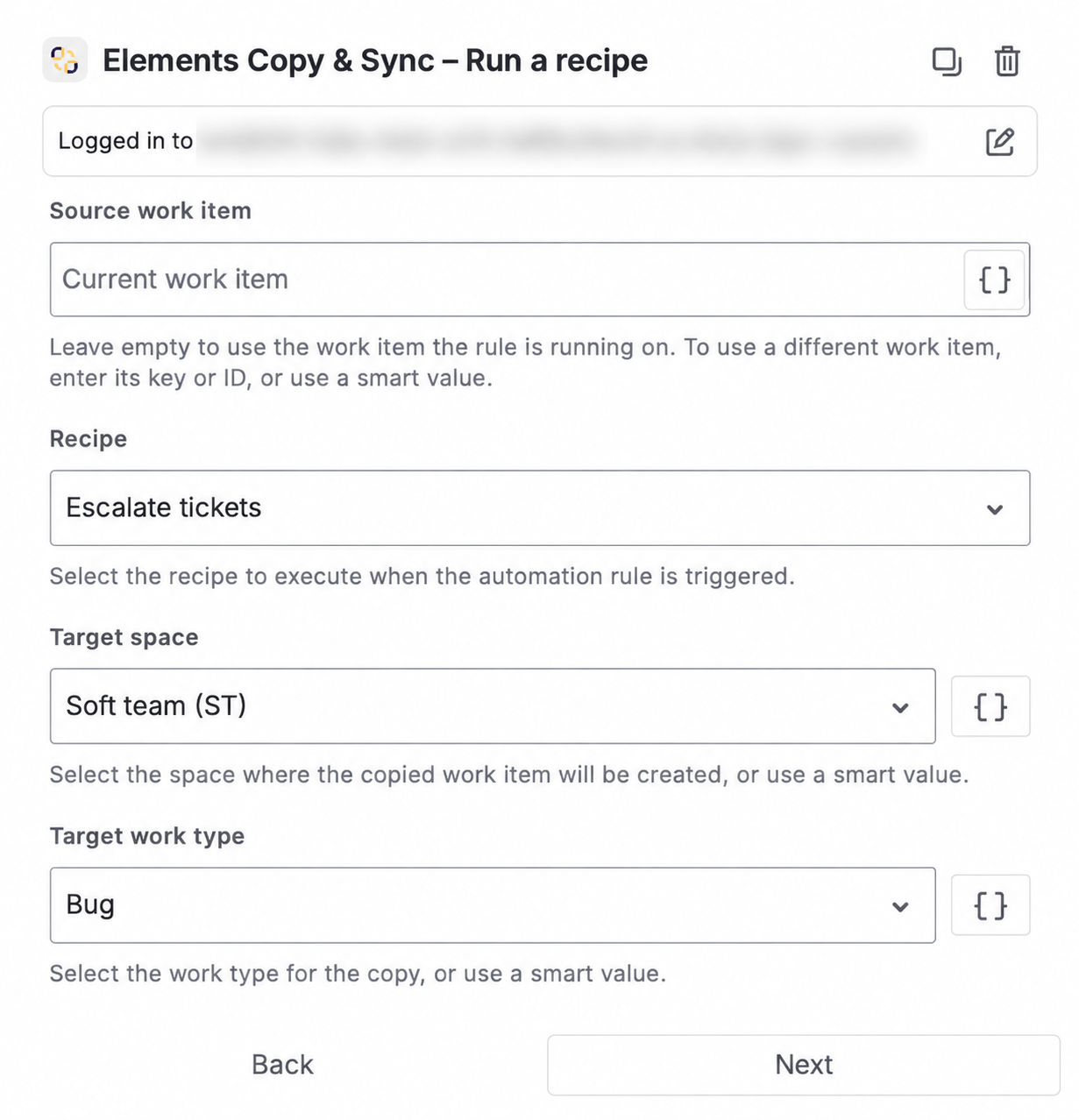
4 - (Optional) You can use smart values to define the Source work item, if different from the current one.
5 - In the Recipe field, select "Escalate ticket".
6 - Select the target space and target work type, or use smart values that resolve to each.
Because Jira Automation runs recipes automatically, no creation dialog is shown, meaning the target project and work item type must be determined beforehand.
You can allow multiple target projects and work item types in a single recipe so it can be reused across different Automation rules. When setting up the Automation action, choose the specific target either from the dropdown list or dynamically using smart values. Note that smart values can only select among the targets already allowed in the recipe.
7 - Name the rule, save and enable it.
Result
Every time someone comments on a work item, the "Escalate ticket" recipe automatically copies it using the configuration defined in Elements Copy & Sync. Beyond creating the new work item, the recipe can apply complex field mappings, synchronize workflow statuses, copy comments and attachments, and keep related items aligned over time. You can adapt the Automation trigger and conditions to match your own use case, while relying on Copy & Sync’s advanced logs to troubleshoot execution, configuration, or synchronization errors.
Going further: Dynamic targets
Instead of creating one recipe per target, a single recipe can send work items to different projects or work types depending on the rule. Allow a set of target spaces and work types in the recipe and select the targets for each rule. Moreover, thanks to smart values, you can define the target dynamically depending on the source space or a value added in a given field. Therefore one Automation rule, with Copy & Sync action, can create issues in different spaces, depending on the context.
Triggering recipes from outside Jira Automation
To run a recipe from an external tool or script, you can still use the REST API with the Send web request Automation action. Check configuration here.
•••
New to Elements Copy & Sync?
If this tutorial has stirred your imagination, why not give it a try?
• Try Elements Copy & Sync for free •